
 Turkish
  English (United States)
  Spanish
  French
  Japanese
  Ukrainian
  Russian
  Korean
  German
  Dutch
Dutch  Hungarian
  Polish
  Italian
  Indonesian
  Portuguese
  Arabic
  English (UK)
You can slow drivers down with no wiring, no mains power, and no tickets. A solar radar speed sign makes that possible. It runs on solar energy, reads each driver’s speed with radar, and shows that speed back to them on a bright LED display. When a driver sees how fast they are going, they usually ease off the accelerator on their own.
This article shows you how solar radar speed signs work, where you should place them, and the exact specifications you need to compare. You will also see how much they cut speeding, how they differ from enforcement cameras, how to install and maintain them, and the answers buyers ask most.
What Is a Solar Radar Speed Sign?
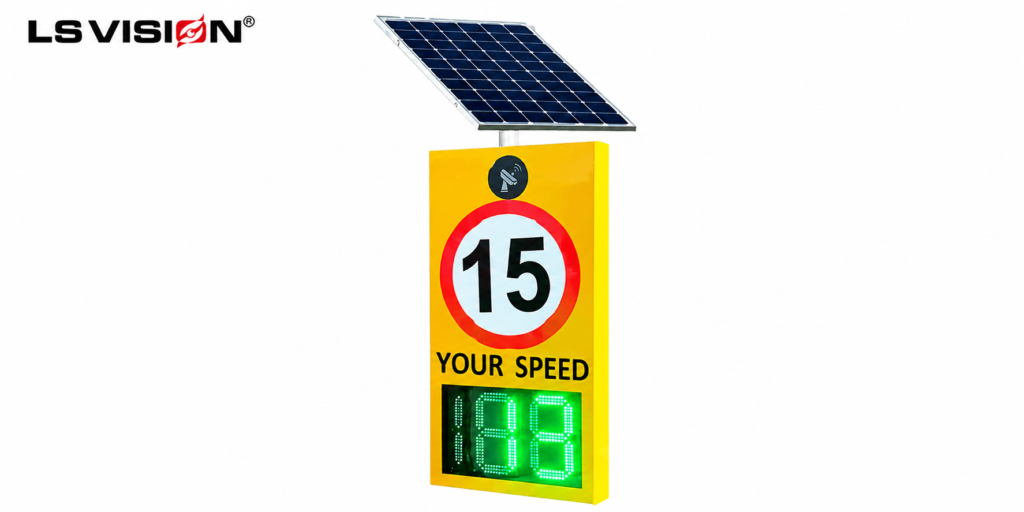
A solar radar speed sign is a driver-feedback device. It measures a vehicle’s speed and shows that number back to the driver in real time. It powers itself with a solar panel and battery, so you install it anywhere — even with no grid nearby.
You may also see it called a driver feedback sign, a “your speed” sign, or a radar speed display sign. The names differ, but the job stays the same. It makes drivers aware of their speed at the one moment that changes behaviour: as they approach.
Three parts do the work:
- The radar sensor. It sits behind the sign face and points down the road. It detects each approaching vehicle and measures its speed from a distance.
- The LED display. It shows the measured speed in large, bright digits. Most units add colour, so the number turns green within the limit and red over it.
- The solar panel and battery. The panel charges a rechargeable lithium battery. The battery runs the sign day and night, so it never depends on mains power.
A static speed-limit plate shows the same number to everyone. Drivers learn to ignore it. A solar radar speed sign reacts to each driver personally. That is why it calms traffic when a fixed sign cannot. And remember one key point: it warns, it does not fine. It has no camera and issues no tickets.
How Does a Solar Radar Speed Sign Work?
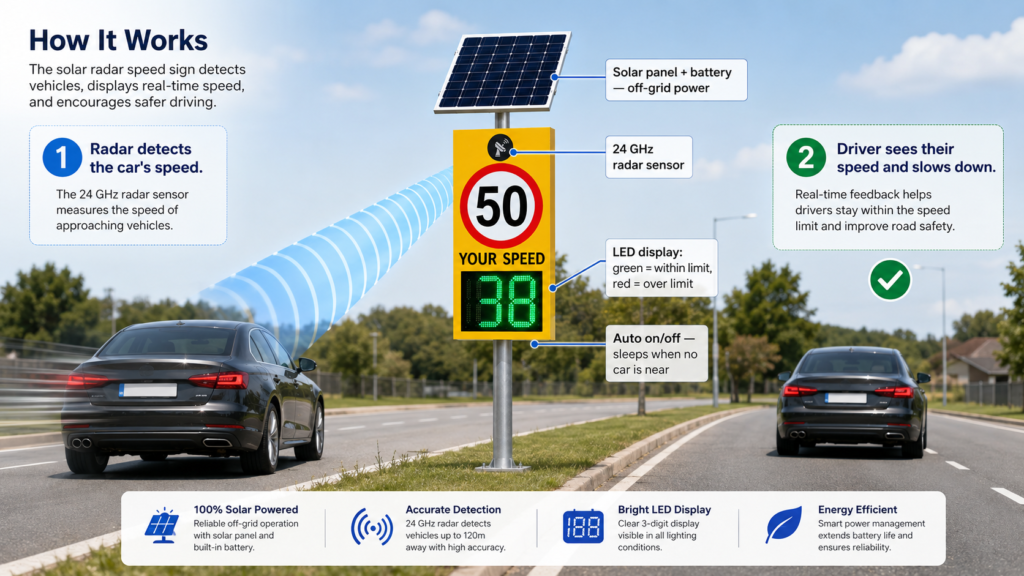
The whole process finishes in under a second, before the driver reaches the sign. Here is each step.The radar reads speed with the Doppler effect. A quality sign, like the LS-RSM20-SP solar radar speed sign, uses a 24 GHz RF millimetre-wave radar with a detection range of over 200 metres and coverage of up to 4 lanes.
| Step | What the sign does |
| Detect | The 24 GHz RF radar picks up the approaching vehicle and measures its speed from over 200 metres away, across up to 4 lanes at once. |
| Display | The LED screen wakes up and shows the driver’s current speed in large digits. |
| Warn | The digits turn green when the driver stays within the limit, and red when they speed. |
| React | The driver sees their own speed, and most slow down at once. |
| Reset | The screen switches off when no vehicle is near, then wakes for the next car. |
Now look closer at how each part performs, because the details decide how well the sign works on your road.
The radar reads speed with the Doppler effect. A quality sign, like the LS-RSM20-SP solar radar speed sign, uses a 24 GHz RF millimetre-wave radar. It sends out a radio signal and measures how the reflected signal shifts as a car moves toward it. That shift gives an accurate speed reading, in real traffic, day or night. Rain, dust, and darkness do not stop it.
The display does more than show a number. Bright LED digits stay readable in direct sunlight and at night. The colour change does the heavy lifting: a red number tells a speeding driver, instantly, that they are over the limit. You can also set the speed threshold, so the sign knows when to switch from green to red on your specific road.
The power system is built to sip, not gulp. The sign only lights up when it detects a vehicle. Between cars, the display sleeps. That single feature slashes power use. It is exactly why the sign runs on a small solar panel and battery instead of a grid connection. You get a unit that measures, displays, and conserves power all at once — and works 24/7 with no cable in the ground.
Do Solar Radar Speed Signs Really Slow Drivers Down?
Yes. And you do not have to take it on faith. Independent traffic studies show that radar speed signs cut average speeds by about 3 to 9 mph after you install them. Those reductions hold for months, not just the first week.
The reason is psychology, not force. You are not punishing the driver. You are handing them a fact they can act on right away. That personal feedback interrupts autopilot driving. Most drivers correct on their own, around the clock, with no officer present.
You also get two effects that make the sign work harder:
- Permanence. Drivers do not “get used to it” the way they ignore a fixed sign. The number changes for every car, so the sign keeps grabbing attention long after you install it.
- The halo effect. Drivers who slow at the sign tend to stay slower for a stretch of road beyond it. So one sign calms more than one point.
And the stakes are real. Speed decides whether a crash becomes a fatality. Research shows a pedestrian hit at 40 mph has about a 1-in-10 chance of survival. At 20 mph, that rises to about 9 in 10. When you cut a few miles per hour, you save lives on your road.
Here is how a solar radar speed sign compares with the tools you may already use:
| Method | Needs staff? | Works 24/7? | Moves easily? | Main drawback |
| Speed bumps | No | Evet | No | Cause noise and vehicle wear; work at one point only |
| Radar gun or patrol | Evet | No | Evet | Work only while an officer is present |
| Static speed-limit sign | No | Evet | No | Drivers stop noticing them |
| Solar radar speed sign | No | Evet | Evet | Warns rather than fines |
You get the round-the-clock, staff-free coverage of a fixed sign, plus the attention of a live speed check — without the cost or friction of enforcement.
The Hidden Cost of Speeding on Your Roads
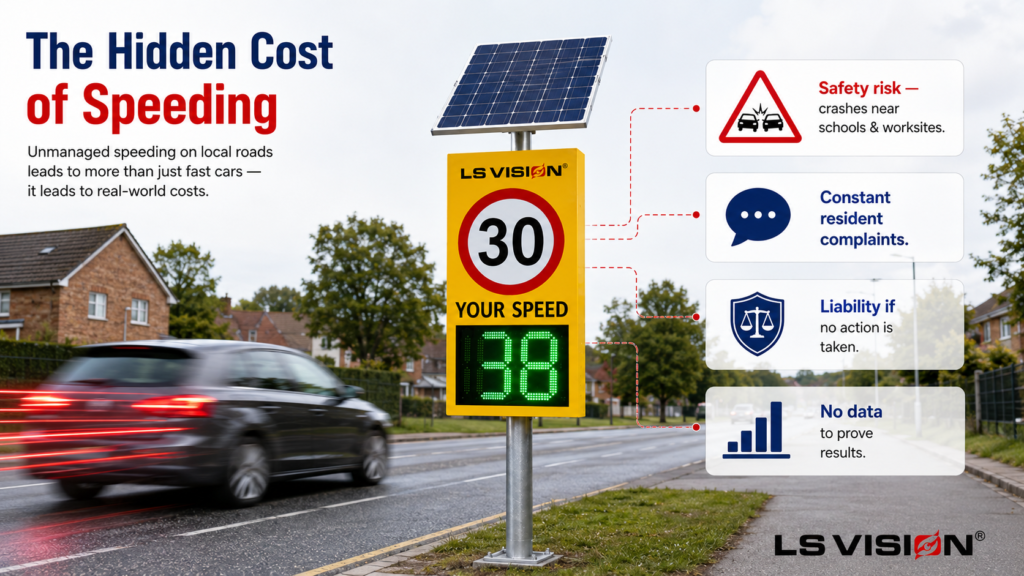
Before you compare products, count what speeding already costs you. This is why so many project owners act.
You carry a safety risk. Every speeding vehicle near a school, a park, or a worksite is a crash waiting to happen. One incident can change lives and trigger a lawsuit.
You field constant complaints. If you manage a community or a private road, speeding is likely your top complaint. Residents want to see action, not another meeting.
You face liability. When you are responsible for a road and you take no visible step to control speed, you carry more risk if something goes wrong. A radar speed sign shows you acted.
You want results you can prove. Budgets need justification. If your sign logs speed data, you can show a clear before-and-after drop and defend the spend.
A solar radar speed sign answers all four. It reduces crashes, it satisfies complaints with visible action, it shows due diligence, and — with data logging — it gives you the numbers to prove it worked.
Solar Power vs. Mains Power: Which Setup You Need
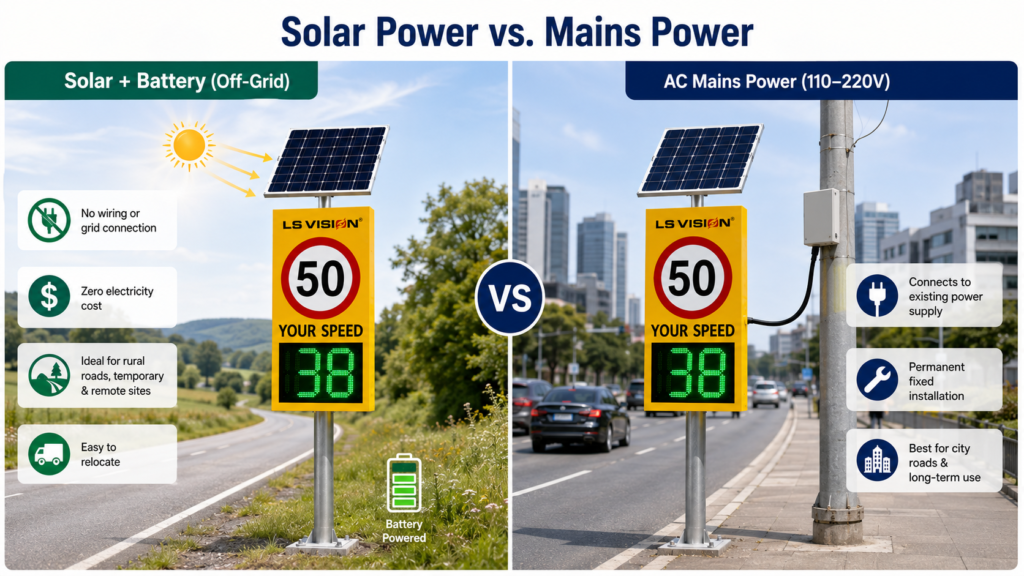
You do not always have power at the roadside. You do not always need a permanent fixture. So the best solar speed signs give you two power options. You run them on a solar panel with battery backup, or on AC mains power at 110–220V.
Choose by location and project type:
| Solar + battery (off-grid) | AC mains power (110–220V) | |
| Best for | Rural roads, temporary projects, sites with no power | City roads and permanent installations |
| Install | No trenching, no grid wiring | Needs an existing power supply |
| Running cost | No electricity cost | Standard electricity cost |
| Uptime in bad weather | Battery carries it through cloudy days | Constant, as long as mains holds |
| Flexibility | Easy to move between sites | Fixed in one place |
Two questions decide your battery and panel size. First, how much sun does the site get? Second, how busy is the road? A well-sized solar unit stores enough charge to run for several days, even through cloudy or rainy weather. So a grey sky does not shut your sign down.
Here is the simple rule. If you have no power at the site, or you may move the sign later, choose solar. If the sign lives on a mains-connected pole in a city, choose AC. A good manufacturer offers both, so you match the sign to the site instead of forcing the site to fit the sign.
Where to Use Solar Radar Speed Signs
Because the sign makes its own power, you place it almost anywhere speeding is a problem. And you move it when your priorities change. Look at where each deployment pays off.
| Location | Why it fits |
|---|---|
| School zones | Reminds drivers to slow down around children at drop-off and pick-up |
| Residential streets | Calms traffic where families, walkers, and cyclists share the road |
| Construction and work zones | Protects workers, and relocates as the site moves |
| Industrial parks and yards | Manages speed around trucks, forklifts, and crossings |
| Rural and remote roads | Brings speed awareness where no mains power reaches |
| Highways and motorways | Handles fast traffic with a 1–250 km/h range and up to 4-lane coverage |
| Temporary safety campaigns | Deploys fast, then moves to the next problem spot |
School zones are one of the most common uses. Posted limits there often drop to 15–25 mph, and drivers need a clear prompt at exactly the right time. A radar speed sign delivers that prompt for every car.
Residential streets generate the most speeding complaints, so this is where communities act first. A driver-feedback sign gives residents visible action. You can read more in this guide on how to improve neighbourhood speed limit compliance.
Work zones and industrial sites need speed control that moves with the job and protects people on foot. A solar unit installs in minutes and relocates just as fast.
Rural roads are where solar earns its keep. No power line? No problem. The sun runs the sign — the same off-grid principle behind solar-powered surveillance for remote monitoring. The flexibility is the point: a sign that installs without wiring also moves without effort, so one unit can cover several problem spots across a year.
Highways and expressways are within reach too. With a speed measurement range up to 250 km/h and coverage of up to 4 lanes at once, you can use the same sign on fast motorways and even racetracks — not just low-speed streets. That makes it a strong fit for municipal and highway projects.
Key Specifications You Should Compare
This is where good signs separate from cheap ones. Two units can look alike and perform nothing alike. Check every point below before you buy.
| Şartname | Why it matters | What to look for |
| Radar type | Decides accuracy and reliability | 24 GHz millimetre-wave radar |
| Detection range | Sets how early the sign warns the driver | Detects vehicles from over 200 metres away |
| Speed detection range | Must cover your road’s real speeds | 1–250 km/h — covers school zones to highways and racetracks |
| Display type and size | Larger, brighter digits read from farther away | 3-digit 2727 high-brightness LED display |
| Colour feedback | Communicates compliance at a glance | Green within the limit, red over it |
| Auto brightness / auto on-off | Saves power and stays readable day and night | Dims and wakes automatically |
| Adjustable limit | Lets you set the “speeding” threshold per zone | Speed-limit shown by a reflective sticker on the sign face |
| Lane coverage | Wider roads need the radar to cover more lanes | Covers 1 to 4 lanes at the same time |
| Power options | Off-grid and fixed sites need different setups | Solar + battery, or AC 110–220V |
| Weatherproof housing | Survives heat, rain, and dust all year | Sealed housing (commonly IP65) |
| Data logging | Lets you prove results and plan | Records speed, volume, and time |
| OEM / ODM support | Lets you brand or customise for a project | Custom hardware, display, and configuration |
Read the table as a checklist, not a wish list. Match each point to your road. A purpose-built unit like the LS-RSM20-SP solar radar speed sign covers these essentials, but a quiet residential street and a fast rural highway still do not need the same setup — the highway needs earlier detection, a bigger display, and wider lane coverage. And if you must justify the spend to a committee or client, insist on data logging. Then you can show a clear before-and-after result instead of a guess.
Radar Speed Sign vs. Automated Enforcement System
You need to understand this difference before you choose. A radar speed sign and an enforcement system look alike on the pole, but they do very different jobs. Pick the wrong one, and you either overspend or fall short.
A solar radar speed sign measures speed and warns the driver. It has no camera. It does not record or identify vehicles. Its job is to change behaviour in the moment. It is simple, fast to deploy, and fits almost any site.
An automated traffic enforcement system adds a licence-plate recognition (ANPR) camera and a data platform on top of the radar. It captures speeding vehicles, reads their plates, and sends the data to a central system. That is the base for issuing fines and building traffic records.
| Solar radar speed sign | Automated enforcement system | |
| Main purpose | Warn drivers, calm traffic | Capture and record violations |
| Camera / plate recognition | No | Evet |
| Data platform | No | Evet |
| Best for | Schools, communities, work zones, rural roads | Cities and authorities that need enforcement records |
| Deployment | Simple and fast | More involved, with backend management |
Choose by your goal. If you want safer speeds through awareness, a radar speed sign is simpler, faster, and fits more sites. If you must capture plates and issue fines, you need a dedicated automated traffic enforcement system instead. Many buyers start with radar speed signs to calm traffic, then add enforcement only where it is truly needed.
How to Install and Maintain Your Sign
You do not need a crew or a power connection to put up a solar radar speed sign. That is a big part of its appeal.
Here is a typical install:
- Mount the sign. You fix it to a standard pole or post with U-shaped clamps. No trenching. No electrician.
- Angle the solar panel. You tilt the panel toward the sun for the best charge through the day.
- Set the speed limit. You apply a reflective speed-limit sticker (for example, 15, 20, or 30) to the sign face, so drivers see the limit alongside their own speed.
- Check the display. You confirm the sign wakes, reads speed, and shows the right colours.
Maintenance stays light. You mainly keep the solar panel clean, so it charges at full efficiency. Wipe off dust and debris now and then, and the sign keeps running. There is no wiring to inspect and no meter to read.
This is why solar signs suit hard-to-reach spots. You install in minutes, and you barely touch the sign afterward. With no cable and a battery topped up by the sun, a good unit runs close to “install and forget” — as long as the panel stays clean and aimed at the sky.
How to Choose the Right Solar Radar Speed Sign
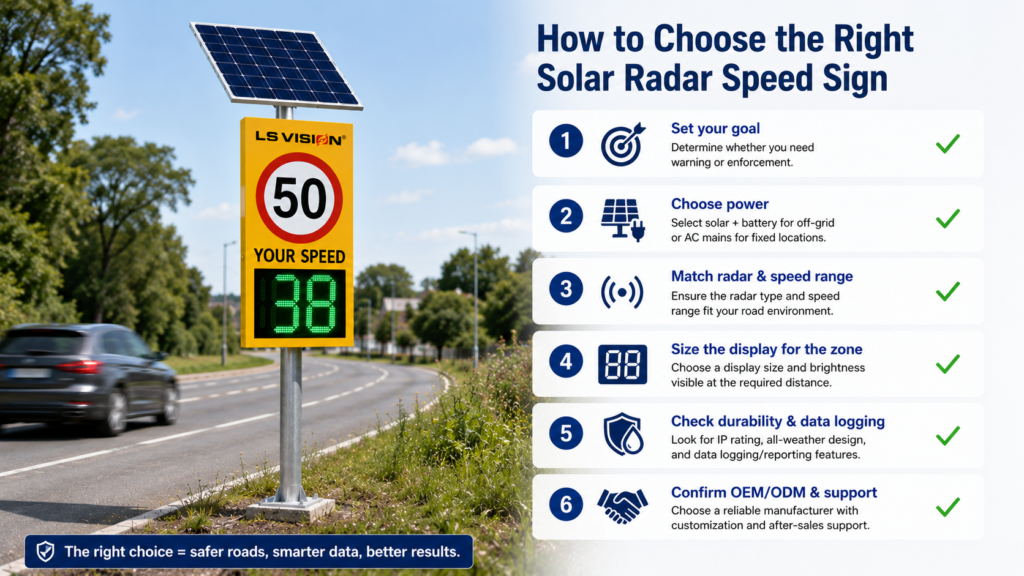
Follow six steps and you will pick the right unit the first time.
Step 1 — Set your goal. Decide if you need warning or enforcement. This one choice sends you to a speed sign or a camera system.
Step 2 — Choose your power. No electricity, or plan to relocate? Pick solar plus battery. Permanent city pole? Pick AC.
Step 3 — Match the radar and speed range. Make sure the sign detects cars early and covers your road’s speeds. Faster roads need earlier detection and wider lane coverage.
Step 4 — Size the display. A high-speed road needs a large, bright display you can read from far away. A quiet street needs less.
Step 5 — Check durability and data. Confirm the housing is weatherproof for year-round use. Ask about data logging so you can prove results.
Step 6 — Check customisation and support. Ask about OEM/ODM if you want branding. Ask about lead time, warranty, and after-sales support.
The biggest mistake is buying on price alone. A cheap sign that fails in the summer heat costs you more in call-outs and replacements than a solid one ever would. Match the sign to your road, and it pays for itself in reliability. When you are ready, ask your supplier for a full spec sheet and a quote, and confirm the exact detection range and power setup for your site.
Common Myths About Solar Radar Speed Signs
Bad information keeps buyers from a tool that works. Clear these up before you decide.
| Myth | Reality |
| “Solar signs stop working on cloudy days.” | The battery stores enough charge to run for several days through overcast and rainy weather. |
| “Radar speed signs give out tickets.” | The sign only shows speed. It has no camera and issues no fines. Enforcement needs a separate ANPR system. |
| “They only work on highways.” | They work on low-speed roads too. School zones, neighbourhoods, and work zones are among the most common uses. |
| “They are hard to install.” | Most solar units mount on a pole with clamps. No wiring or grid connection required. |
| “One sign fits every road.” | Radar range, display size, lane coverage, and power should all match the specific site. |
| “Drivers ignore them after a while.” | The number changes for every car, so the sign keeps drawing attention long-term. |
Why It Pays to Buy From a Specialist Manufacturer
Where you buy matters as much as what you buy. A cheap, generic sign may fail in the first hot summer. A sign built for the job keeps working for years.
When you source from a specialist manufacturer, you get:
- Hardware built for the outdoors. A sealed housing, quality LEDs, and a proper solar and battery system survive heat, dust, and rain.
- The right power version for your site. You get solar or AC, sized correctly, instead of a one-size box.
- OEM/ODM customisation. You add your branding, adjust the display, or tailor the configuration for a project.
- Real support. You get a spec sheet, warranty, spare parts, and after-sales help — not a mystery product.
If you plan a traffic-calming project, or you resell signs to your own clients, this is the difference between a smooth deployment and a stream of complaints. Start by sending your requirements — your road type, speeds, power situation, and quantity — and ask for a tailored recommendation and quote.
FAQ’s
How does a solar radar speed sign work?
It uses radar to measure each approaching vehicle’s speed, then shows that speed on an LED display. A solar panel and battery power it, so it runs day and night with no mains connection.
Do solar radar speed signs work on cloudy or rainy days?
Yes. The panel charges a battery, and the battery stores enough power to run for several days. So your sign keeps working through overcast and rainy weather, not just in bright sun.
Do solar radar speed signs give tickets?
No. The sign only shows a driver’s speed. It has no camera and issues no fines. To capture plates and issue fines, you need a separate enforcement system with ANPR.
How much do radar speed signs cut speeding?
Studies show average drops of about 3 to 9 mph after you install one. The effect lasts for months, not days.
How far can the radar detect a vehicle?
The 24 GHz RF radar detects vehicles from over 200 metres away, across up to 4 lanes at once, which gives drivers plenty of time to react.
Can you change the speed limit shown on the sign?
Yes. You apply a reflective speed-limit sticker to the sign face, so you can set the posted limit for each location.
Are solar radar speed signs good for school zones?
Yes. School zones are one of the most common uses. The sign reminds drivers to slow down around children, with no power supply or officer needed.
Should you choose solar or AC power?
Choose solar plus battery for sites with no power, or when you may move the sign. Choose AC for a permanent pole on a mains-connected city road.
How do you install a solar radar speed sign?
You mount it on a pole with clamps, angle the solar panel toward the sun, and set the speed limit. There is no wiring or grid connection to arrange.
